Table of contents
Range anxiety has a cousin: charging anxiety. As EV sales keep rising, drivers are discovering that the hardest part is not the motor, it is the minutes, the queues, and the patchy reliability of public chargers, especially for fleets and last-mile riders who cannot afford downtime. Battery swapping, once a niche idea, is returning to the debate as cities tighten air-quality rules and delivery demand accelerates. Could automated swapping kiosks offer the kind of predictable “pit stop” experience that today’s charging network still struggles to provide?
Fast, predictable, and built for uptime
What if the “refuel” took minutes, every time? That promise is what keeps battery swapping in the conversation, even after years in which fast charging grabbed most of the headlines. The logic is operational as much as technological: instead of waiting for electrons to flow into a pack, the driver exchanges a depleted battery for a charged one, and the station handles the slow part, charging in the background, balancing loads, and keeping an inventory ready for the next user.
Real-world examples show why the idea appeals to high-utilisation users. In China, NIO has scaled a nationwide swapping network and regularly reports thousands of swap stations in operation, with automated swap times advertised in the single-digit minutes, while also using swapping as a way to decouple vehicle cost from battery ownership for some customers. For two- and three-wheelers, swapping has already become mainstream in parts of Asia: Taiwan’s Gogoro network is frequently cited as a reference model, because dense urban coverage and small modular batteries make the economics easier, and the time saved translates directly into more deliveries, more rides, and less frustration.
The benefit, however, is not only speed. It is predictability, which is the currency fleets care about. A fast charger rated at 150 kW or 350 kW can still disappoint if it is occupied, down, derated by heat, or constrained by the grid connection; a swapping system, if properly managed, aims to reduce variability by standardising the exchange process and by charging batteries at rates optimised for longevity rather than raw peak power. That matters because battery health is a cost centre, and aggressive fast charging can accelerate degradation under certain conditions, especially if thermal management is not optimal.
Battery swapping also creates a new lever for grid management. Because charging happens “behind the curtain,” operators can shift charging to off-peak periods, reduce demand spikes, and potentially integrate on-site storage or renewables. In a world where distribution grids in many cities are struggling to keep up with electrification, that flexibility is more than a nice-to-have, it can be the difference between deploying infrastructure quickly and waiting years for a network upgrade.
Standardisation: the make-or-break ingredient
Here is the uncomfortable truth: swapping is easy to demo, and hard to scale. The central challenge is standardisation, because batteries are not like fuel nozzles, they are structural, high-voltage components tied into cooling, safety systems, and vehicle design. Without common formats, each brand risks building its own closed ecosystem, which limits utilisation, increases capital costs, and weakens the network effect that makes public infrastructure viable.
Some markets are trying to tackle this head-on. China has promoted standard-setting efforts for swappable batteries in certain segments, and several manufacturers have explored alliances, yet the landscape remains fragmented, especially for passenger cars. Two-wheelers are different: smaller packs, simpler interfaces, and faster model cycles make it easier to converge around compatible modules. That is one reason why swapping has advanced further for scooters and motorcycles than for family SUVs.
Safety regulations add another layer. Swapping involves repeated mechanical handling of heavy, high-energy devices, with connectors that must remain reliable across thousands of cycles and in harsh conditions, from winter road salt to summer heat. Fire safety, ventilation, thermal monitoring, and cybersecurity are not side issues; they are core requirements, particularly if stations operate unattended 24/7. Regulators, insurers, and municipalities will expect auditable procedures, clear responsibilities, and robust incident response plans.
Then there is the customer proposition, which is inseparable from standardisation. If a driver cannot trust that a station will have the right battery model in stock, or if subscription terms are opaque, the anxiety simply shifts from “Will I find a charger?” to “Will I find my battery?” That is why mature swapping networks emphasise real-time availability, reservation logic, and consistent service-level targets, much like the best mobility platforms do today.
Where kiosks fit: streets, depots, and dense cities
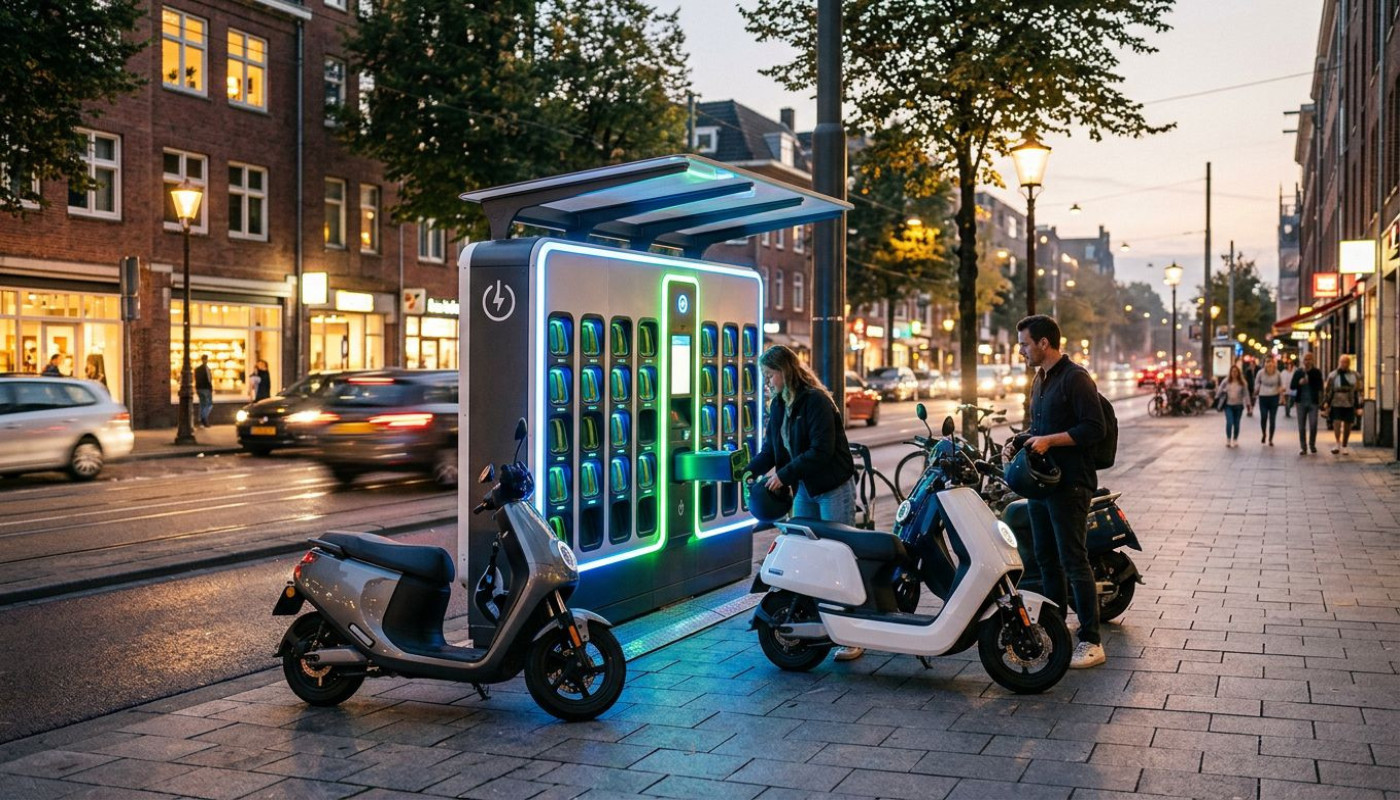
Think smaller than a charging hub. Think closer to the rider. Battery swapping often becomes most compelling when the infrastructure can live where vehicles already are: near delivery hot spots, transit nodes, depots, and residential clusters with limited private parking. This is where compact, automated kiosks enter the discussion, because they can be deployed with a lighter footprint than large charging plazas, and they can serve frequent, short-range users who cycle through batteries quickly.
For last-mile logistics, time is not an abstract metric, it is margin. A courier on an e-scooter or an electric cargo bike may need multiple “refuels” per day, and even a 20-minute top-up can be operationally disruptive, especially if charging points are scarce or unreliable. With swapping, the vehicle returns to service almost immediately, and the operator can centralise battery health management, track usage, and retire packs before they become risky. In practice, that can reduce downtime, extend asset life, and improve route predictability, three outcomes that fleet managers will pay attention to.
Deployment also depends on the electrical reality of a city. A kiosk that charges batteries internally can, depending on design, draw power in a smoother profile than a bank of high-powered DC fast chargers, and it can be configured to match local constraints. That does not eliminate the need for grid capacity, but it can make permitting and connection planning more manageable, particularly in dense urban environments where trenching and transformer upgrades are expensive and slow.
Industrial design matters, too. A kiosk has to be secure, weather-resistant, and simple enough for a first-time user under pressure, while remaining serviceable for operators. That is why turnkey hardware platforms are drawing interest from mobility companies and municipalities evaluating pilots. Solutions such as kiosks aventech illustrate how manufacturers are packaging swapping into modular units intended for public or semi-public deployment, with an emphasis on automation, access control, and scalable rollout. The kiosk is not the whole system, but it is the visible interface, the point where trust is won or lost.
The real test: economics, not engineering
The technology can work. The question is whether it pays. Battery swapping shifts costs from drivers to infrastructure operators, who must finance not only stations, but also a pool of batteries, plus maintenance, software, and field operations. The economics therefore hinge on utilisation rates: the more swaps per day per kiosk, the faster the capital cost is amortised, and the more resilient the business model becomes.
This is why swapping often targets fleets first. A delivery company, a ride-hailing operator, or a shared-mobility provider can provide predictable throughput, and can place kiosks where demand is guaranteed, such as depots or high-traffic zones. Consumer adoption can follow, but it is harder to bootstrap without anchor customers. Subscription models can also help, turning uncertain per-kWh revenue into recurring income, although they require transparency to avoid backlash over perceived lock-in or variable battery quality.
Battery ownership is another pivot point. If the battery is decoupled from the vehicle, operators can treat it as a managed asset, optimising charge rates and rotation to extend life. For consumers, battery-as-a-service can lower the upfront price of an EV, but it can also raise concerns about long-term fees and resale value. In markets where car buyers expect full ownership, this cultural factor can be as decisive as any technical specification.
Finally, public policy will influence outcomes. Many jurisdictions offer subsidies for charging infrastructure, but swapping may fall into grey areas, even if it delivers similar climate benefits. Cities pushing for electrified delivery zones or low-emission areas could accelerate adoption by supporting pilots, streamlining permits, and recognising swapping within infrastructure funding rules. Absent that, swapping will still grow where it is obviously superior, yet it may remain a specialised solution rather than a universal standard.
How to try it without regrets
Start with a pilot in a high-use zone, and insist on clear service metrics: availability, average swap time, and battery health reporting. Budget for operations, not just hardware, and check whether local or national programmes support clean mobility infrastructure. If you manage a fleet, negotiate reservation access and maintenance terms upfront, then scale only once utilisation proves the case.
Similar

Recent Breakthroughs In AI Image Generation Technology

Breaking News: Advances In AI Image Generation Technology
